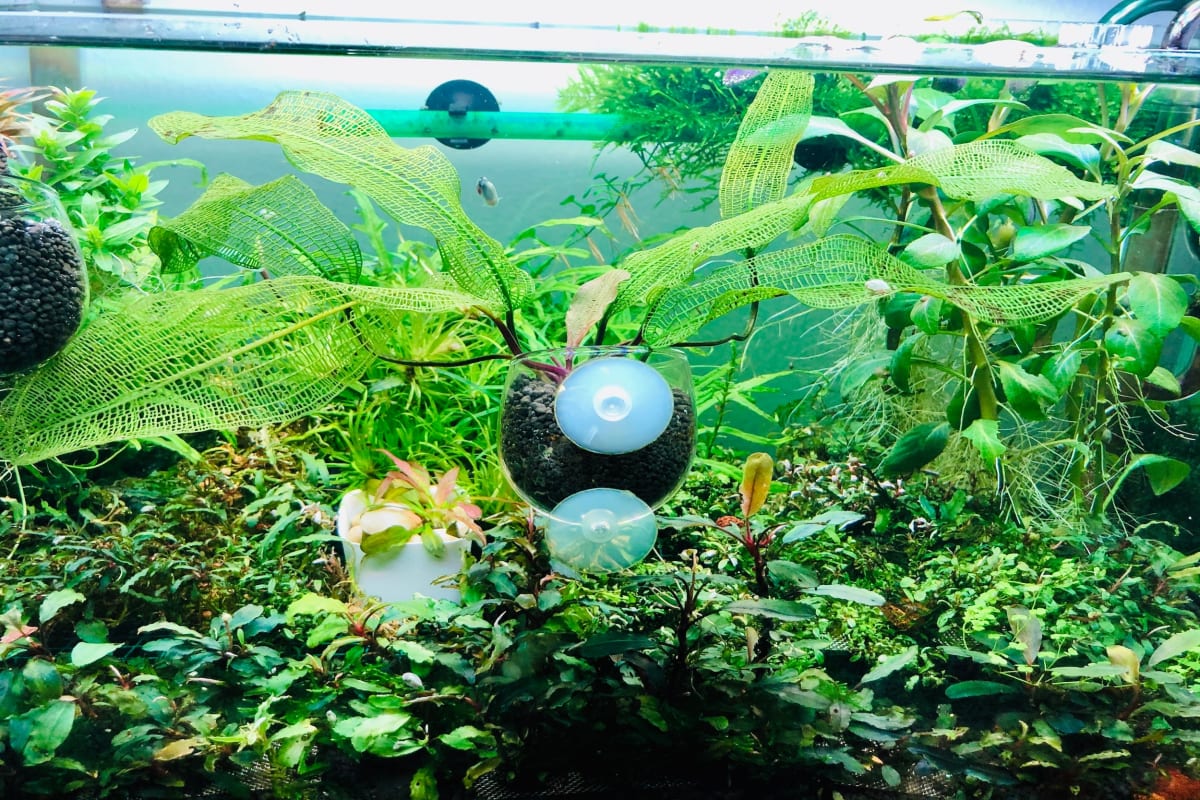
Aponogeton Madagascariensis (Narrow leaf)
Product Description
Aponogeton Madagascariensis fact sheet
• Difficulty: Average
• Family: Aponogetonaceae
• Gender: Aponogeton
• From: Madagascar
• Lighting: Average
• Temperature: 20 - 24 ° C
• Growth: Quick
• PH: 4.5 - 6.5
• Hardness: 2-12
• Co2: Optional
Characteristics of Aponogeton Madagascariensis
While the related species have a regular reticular structure, here they are irregular, giving rise to an interesting appearance, like A. madagascarensis, this aquatic plant is also native to Madagascar. TO temperatures permanent of 20º to max. 24 ° C plants emerge even without dormancy.
For healthy growth, a nutrient-rich substrate is required, so the supply of nutrients and iron over the water must also be ensured by regular fertilization. Good lighting thanks to Aponogeton madagascariensis with a compact wax.
The elongated tubers of Aponogeton madagascariensis should be placed in a part of the soil. Plants already rooted in the area facilitate their own root formation. These should prefer semi-shady to shady places, such as Aponogeton madagascariensis with the formation of 1-2 leaves grows rapidly about it monthly. The wide, round and oval leaves can reach 20-50 cm long and other plants quickly take light. With a total height of 50 cm, care is only recommended in sufficiently large aquariums.
Adjust environmental conditions, the natural resting phase of Aponogeton madagascariensis. New leaves are then constantly being formed over several years. Often blooms in the aquarium. The white to yellow inflorescence sits on a stable stem and develops encapsulated fruits, the seeds of which first float to the surface of the water and then sink into the ground where they can take root. In well-bred rhizomes, propagation is also possible by dividing the rhizome, but the tubers should not be damaged.
Aponogeton madagascariensis, in addition to the nutrient-rich substrate, soft water and colder and regular water changes. The temperatures are ideally in the range of 18º - 24 ° C. Warmer water has lower growth height and smaller leaves, but 25 ° C should not be permanently exceeded. The hardness of water can be between 2 - 12 ° KH, the pH value in the range of 4.5-6.5 it would be ideal. Aponogeton henkelianus, the large-leaved or even narrow-leaved lattice-leaf plant, is a grateful grower if you pay attention to it through frequent water changes and provide it with gentle, vigorous-moving water. In flatter aquariums, the relatively large leaves of this plant are found on the surface of the water and take too much light from the aquarium plants in the lower areas.
Key Features
- Premium quality
- AQUATIC SWAN DESIGN
- Fast shipping
You May Also Likeplants category

Marimo Moss Ball
- MARIMO living moss ball suitable for cold or tropical aquariums. Excellent gift for your friend or loved ones to signify everlasting love.... - This Ball is a chic aquatic species, handsome in appearance, easy to keep, very suitable for shrimp and other small cylinder feeding, can increase the aesthetics, while contributing to water quality and stability. Do not enter the soil when planting, you can directly placed in the water.

Alternanthera Reineckii - Live Aquarium Plant Fish Tank
- Price per portion. Portion: submersed growth 2 stems (around 5cm long each stem) - It is particularly suitable for small aquariums or as a foreground plant in larger aquascapes. By careful trimming, it is possible to create a dense, red violet carpet of approximately 5 to 10 cm height. High light intensity and addition of CO2 improves the plants growth and overall appearance. - Originated from South America, Alternanthera Reineckii, in its wildest form grows best in submerged condition. It is found lying on riversides, wetlands, and in moistened areas due to flooding caused by rains.

Cryptocoryne Parva
Crypt Parva is one of the smallest species of Crypts. It has green, grass-like leaves which can grow up to 4” tall, making it a suitable foreground and midground plant. Compared to other Crypts, it has a very slow rate of growth and can require more light. Cryptocoryne Parva is extremely slow growing and will require patience to achieve lush growth! Cryptocoryne prefer not to be moved once planted. If possible, do not move them! Do not make drastic changes to the aquarium. Unstable parameters will result in melt and rotting of the aquarium plant. Please be sure to remove this plant from its pot. Remove the cotton surrounding the roots and plant into a quality substrate. For instructions on how to properly plant "potted" aquarium plants, click here . CO2 injection and quality aquarium soil will yield better growth. Please research appropriately to ensure your plant thrives. Family Name: Araceae Origin: Sri Lanka Height: 2-4”” pH: 6-7.5 Care: Easy Light: Low Co2: Not Required Propagation: Separate by Rhizome Growth rate: Slow to Moderate